
Barndominiums – often affectionately called “barndos” – have gained popularity in Virginia’s rural areas as an attractive and cost-effective housing option. These are typically metal or pole-barn structures converted into spacious homes. Southwest Virginia, in particular, with its farmland and scenic countryside, has seen an uptick in barndominium projects. One key to making a steel barn into a comfortable home is top-notch insulation. In this article, we focus on how spray foam insulation empowers Virginia barndominiums to achieve exceptional energy efficiency and comfort, even in the face of our region’s hot summers and chilly mountain winters.
Barndominiums in Virginia – An Overview
Barndominiums provide a blend of rustic charm and modern convenience. They usually feature open floor plans, high ceilings, and large workshop or garage spaces attached. Structurally, most barndos in Virginia are built with metal siding and roofing on a steel frame (though some use wood pole framing). This means they share a challenge: metal is a very poor insulator. Without proper insulation, living in a metal building would be impractical – it would be too cold in winter, too hot in summer, and you’d face condensation “rain” indoors when warm air hits the cold metal. Therefore, insulation is not an afterthought but a central component of barndominium construction.
Virginia’s climate varies from the Tidewater to the Appalachians, but broadly we contend with warm, humid summers and moderately cold winters (with more severe cold in the mountains). For barndominiums in areas like Grundy or Pearisburg (in the southwest VA hills), winters can bring snow and single-digit temps, while summers reach the 80s/90s with high humidity. Insulation needs to handle those extremes. That’s why many builders and owners turn to spray polyurethane foam insulation. Spray foam’s ability to seal air leaks and provide a high R-value in one application is perfectly suited to insulating a barndo’s metal shell.
In fact, barndominiums are most common in states like Kentucky and Tennessee (and by extension SW Virginia) where rural land and metal building culture meet energy-conscious homeowners. And in those regions, spray foam is frequently cited as the best insulation choice for barndos. Let’s delve into the reasons.
Spray Foam – Insulating and Sealing in One Step
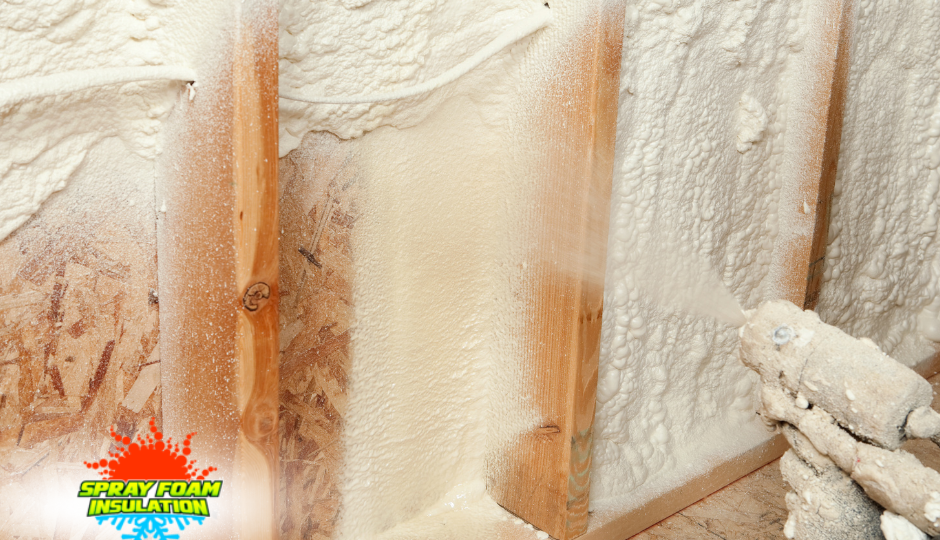
Spray foam insulation comes in two main types: open-cell and closed-cell. Both can be used in barndominiums, but closed-cell is often favored for metal buildings due to a few key advantages. Closed-cell foam is denser and provides a vapor barrier when applied at sufficient thickness, which helps control moisture on metal surfaces. It also has a higher R-value per inch (around R-6 to R-7). When sprayed on the inside of metal siding or roofing, closed-cell foam adheres strongly, essentially gluing the structure and adding rigidity (which can increase wind resistance of the panels). It expands slightly as it cures, filling gaps and sealing tightly against the metal and framing.
The immediate effect of spray foam is that it stops air infiltration dead in its tracks. In a conventional frame house, up to 30-40% of energy loss can be from air leaks – spray foam virtually eliminates that through the insulated surfaces. In a barndo, gaps around frame members and overlaps of metal panels could be leak points; spray foam covers and seals them. This airtightness is huge: a less leaky home is easier and cheaper to heat and cool. One might ask: doesn’t a building need to breathe? Yes – but you want controlled ventilation, not random leaks. With spray foam, we tighten the structure and then use planned ventilation (like an ERV or simply opening windows when needed) to ensure fresh air, rather than having a drafty shell.
Energy efficiency gains from spray foam in barndos are well documented. Some builders report that customers with fully spray-foamed barndominiums see energy bills comparable to or even lower than same-size conventional houses, because the large, open interior benefits greatly from the airtight, well-insulated envelope. As a rough figure, spray foam can cut the overall heat loss of a metal building by 50% or more compared to no insulation, and significantly even compared to fiberglass (which doesn’t seal air). One barndo owner in a realtor.com story noted that with spray foam and efficient design, their cooling costs in a Texas barndominium were much lower than expected – showing that even in harsh climates, barndos can be efficient.
Moisture Management and Durability
Moisture is a prime concern in metal buildings. Condensation can occur on any cool surface when humid air contacts it. Spray foam addresses this by keeping the interior face of metal panels from getting cold (since they’re insulated) and by keeping humid air away from those panels. Closed-cell foam’s vapor barrier qualities keep moisture from migrating through, and by sealing gaps, you don’t have moist outside air pumping in constantly. Think of an uninsulated barn: on a cold morning, you’ll see the metal dripping with dew on the inside. In a spray-foamed barndo, that doesn’t happen – the foam keeps the surface temperature above the dew point and there’s no exposed metal for moisture to condense on.
Additionally, spray foam does not absorb water to any significant extent (closed-cell in particular is very resistant). So even if there is a small roof leak, the foam might actually prevent it from dripping inside by sealing the area – though of course leaks should be fixed, it’s nice that foam won’t be ruined by a little water the way fiberglass would. As a result, your insulation maintains its performance over time. Closed-cell foam is also not a hospitable environment for mold. It’s inert and mold can’t eat it. In fact, by reducing moisture, it indirectly prevents mold on other materials too. This is a big plus for maintaining good indoor air quality.
One aspect people love about spray foam in barndos is the enhanced structural strength. We touched on this: closed-cell foam can increase wall racking strength considerably. While I wouldn’t rely on it as the only reinforcement, it’s reassuring for those in areas of high wind (like open fields or hilltops in Virginia) that their foam insulation is actually adding resilience. There’s even anecdotal evidence of foam-insulated buildings faring better in storms (standing seam metal roofs sprayed underneath can be more resistant to uplift, for example). The NAHB Research Center has demonstrated improved structural stiffness with SPF in walls.
Comfortable Living in a Barn Home
All the efficiency is great, but what about day-to-day comfort? Spray foam creates a very even temperature distribution in a barndominium. Typically, these structures might have had hot zones near the metal roof or cold zones by walls in winter. Once foamed, the interior surfaces stay closer to room temperature. That means no more “radiant chill” or “radiant heat” from the walls and roof – an effect people sometimes underestimate. In an uninsulated or poorly insulated building, even if the air is at 70°F, if you stand near a cold metal wall your body feels that cold radiation. With a foamed wall, the interior surface might be, say, 65°F on a cold day instead of 30°F, so you don’t feel uncomfortable near it.
Spray foam also helps with sound control. Metal buildings can be echoey. Open-cell foam is particularly good at absorbing sound (closed-cell a bit less so due to density). Many barndominium builders use open-cell foam in the walls for soundproofing interior noise (like between living area and shop area) and closed-cell on the roof for structure/moisture. The combined result is a much quieter interior – rain on the roof becomes a gentle white noise rather than a roaring drum, and outdoor sounds (like wind or tractors) are muted. Given that barndos often have large open layouts, controlling sound can make the living space more pleasant.
From a resale perspective, having professionally installed spray foam is a strong selling point. It indicates the home was built with quality and efficiency in mind. Buyers are increasingly savvy about energy features. A barndominium in Lebanon, VA for example, that boasts “spray foam insulated throughout” in its listing will attract positive attention for lower operating costs and better comfort.
Getting It Done Right
Spray foam application in a barndominium is a job for trained pros (like our team). The process typically happens after the building is dried in (walls and roof up). We often spray the roof interior first (especially if using closed-cell, to ensure a good vapor seal upwards), then the walls. It’s important to cover and protect windows, doors, and any finish elements from overspray – experienced contractors do this routinely. Ventilation during curing is also needed, as SPF installation has chemicals that need proper handling (we wear protective gear and ensure vapors are exhausted).
One consideration is that closed-cell foam, when used on large expanses like a roof, must be applied in multiple passes to get the desired thickness (because it gives off heat as it cures). We do that carefully to avoid any issues. The target is usually around 2–3 inches of closed-cell on walls (R-12 to R-18) which is often plenty when combined with an outer metal skin and maybe interior finish, given the airtightness. Roofs might get more, say 4–5 inches (R-25 to R-35) especially if it’s a vaulted ceiling situation.
After spraying, the foam can be left as is (many barndo owners don’t mind the look in utility areas or garages) or it can be covered with drywall or liner panels for a finished appearance. Fire code typically requires a thermal barrier (like drywall) or an intumescent coating over spray foam if it’s left exposed in occupied spaces – we advise clients on these requirements to ensure safety and code compliance. In shop areas, a common solution is white metal liner panels that both protect the foam and give a bright finish.
In summary, an energy-efficient Virginia barndominium is very attainable with the help of spray foam insulation. It turns what could be a cavernous metal box into a tight, comfortable home that rivals any stick-built house. As specialists in spray foam, we take pride in helping folks achieve their dream of a barndo that isn’t just stylish and spacious, but also a joy to live in day-to-day for its quiet, consistent comfort.
If you’re planning a barndominium in Virginia – whether it’s in the highlands near Independence or on a farm outside Richlands – we’d be excited to partner with you.
Contact Pikeville Spray Foam Insulation for expert guidance on insulating your metal building home. We’ll work with your building team to ensure every inch is properly insulated and sealed. With our services extending throughout Southwest Virginia and beyond, we have the local knowledge and experience to do the job right. Harness the power of spray foam for your barndominium, and enjoy country living with modern efficiency!
